“Feldenkrais & Health: Connecting Across Europe” — That was the guiding theme of the project’s second pan-European online meeting, held on Tuesday, 30 September 2025, under the title “Bridging Disciplines to Enhance Care in Chronic Pain and Fibromyalgia: A Feldenkrais4Life Pilot.” Of 226 people who registered, 97 participated in the meeting.
Building on the first pan-European event (January 2025), this session explored how the Feldenkrais Method can be integrated into healthcare. It brought together certified Feldenkrais practitioners, medical and paramedical professionals, and specialists from wellness and healthcare fields.
We began with an introduction to the pilot project about integrated care for fibromyalgia patients to illustrate how collaboration with other professionals can work in practice. The format was both experiential and conversational, designed to deepen participants’ understanding of key aspects of the Feldenkrais Method (FM), including:
- Slowness as a teaching and learning tool.
- The adaptability of FM to diverse needs and populations.
- The promotion of functional movement.
Participants from outside the Feldenkrais community expressed considerable interest in applying the Method in various contexts — for example, with multiple sclerosis. However, we regrettably saw less engagement from professionals in other sectors than we had hoped. To make our gatherings more dynamic and inclusive, we’re rethinking the format.
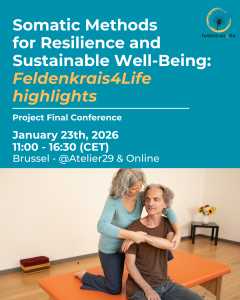
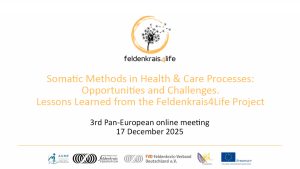
That brings us to the third pan-European meeting — and this time, we’re opening the doors even wider. We’re hosting a full-fledged dissemination event, and we’re especially welcoming potential stakeholders to join the conversation.
We’ll dive deeper into how the Feldenkrais Method can be brought into medical-healthcare environments by Feldenkrais practitioners and somatic-movement professionals. Through a series of interviews, we’ll highlight inspiring success stories as well as the challenges that still need to be tackled.We’d love for you to be part of it! Feel free to bring along colleagues from different somatic disciplines — as well as anyone who might have a stake in this work. The more perspectives we gather, the richer our exchange will be.